
How to Give Seedance Audio Prompts for How the Voice Should Sound
Introduction: The Paradigm Shift in Generative Voice Control
In the rapidly evolving landscape of generative artificial intelligence, audio synthesis has transitioned from rigid text-to-speech (TTS) engines to fluid, emotionally aware foundational audio models. At the forefront of this revolution is Seedance Audio—a state-of-the-art multimodal audio synthesis framework designed to process nuanced contextual directives and translate descriptive natural language into highly specific vocal textures, emotional timbres, and spatial acoustics.
Unlike traditional TTS systems that rely on mechanical emotion tags (e.g., <emotion="happy">) or fixed voice clones, Seedance operates on latent acoustic embeddings guided by multi-layered text conditioning. This paradigm allows creators to define not merely what is said, but the precise physical, psychological, and environmental characteristics of how the voice should sound.
Mastering Seedance audio prompts requires moving beyond simple adjectives like "friendly" or "sad." It demands an understanding of acoustic physics, vocal physiology, dramatic direction, and latent space navigation. This comprehensive guide details the architecture of effective voice prompts, offers structural frameworks, analyzes real-world industrial case studies, and provides troubleshooting methodologies for achieving exact voice signatures.
Part 1: The Core Architecture of Seedance Voice Prompting
To consistently achieve desired voice attributes in Seedance, prompts must be constructed using a systematic multi-axis syntax. A poorly constructed prompt creates ambiguity in the model's diffusion latent space, leading to generic outputs or vocal instability.
The Five Pillars of Vocal Prompting
Every Seedance voice prompt should ideally address five primary acoustic dimensions:
                  +-----------------------------------+
                  |      1. Vocal Persona & Age       |
                  +-----------------------------------+
                                    |
                  +-----------------------------------+
                  | 2. Timbre & Physical Characteristics|
                  +-----------------------------------+
                                    |
                  +-----------------------------------+
                  |  3. Emotional State & Cadence     |
                  +-----------------------------------+
                                    |
                  +-----------------------------------+
                  |  4. Vocal Delivery & Mechanics    |
                  +-----------------------------------+
                                    |
                  +-----------------------------------+
                  |  5. Spatial & Recording Environment|
                  +-----------------------------------+
1. Vocal Persona & Age Demographics
Define the underlying vocal apparatus, gender, age range, and cultural or regional accent baseline.
- Bad: A young woman.
- Good: A 28-year-old female speaker with a subtle Mid-Atlantic accent and a warm tone.
2. Timbre & Physical Characteristics
Specify the resonance, vocal fold thickness, texture, and spectral weight of the voice.
- Descriptors: Gravelly, velvety, raspy, sibilant, chesty, nasal, resonant, reedy, smoky, crisp, guttural.
- Example: A deep, resonant baritone with a slight rasp at the tail end of phrases.
3. Emotional State & Subtext
Capture the internal psychological state, which dictates pitch variability, micro-tremors, and prosodic pacing.
- Descriptors: Quietly confident, suppressed panic, restrained joy, melancholic, exasperated, analytical.
- Example: Delivered with quiet, authoritative restraint, masking a subtle layer of anxiety.
4. Vocal Delivery & Micro-Mechanics
Describe the physiological performance: breathing patterns, articulation speed, pause structures, and vocal fry.
- Descriptors: Rapid staccato articulation, shallow inhalations, elongated vowels, heavy glottal stops, breathy whisper.
- Example: Measured pacing at 120 WPM, with audible shallow breaths between clauses and crisp consonant articulation.
5. Acoustic Environment & Microphonic Context
Indicate where the audio is captured. Seedance models simulate spatial reverb, proximity effect, and microphone characteristics directly within the generated waveform.
- Descriptors: Near-field studio condenser microphone, untreated hardwood room, vintage radio broadcast filter, stadium PA system.
- Example: Close-miked studio recording with zero room reverb, prominent proximity effect, and hyper-clean high frequencies.
Part 2: Structural Prompt Syntaxes and Modifiers
Formula 1: The Layered Descriptor Block
The most reliable method for controlling voice output in Seedance is the bracketed modular syntax. This isolates parameters, preventing descriptor bleed.
[Voice Profile]: {Gender}, {Age Range}, {Accent/Dialect}
[Timbre & Texture]: {Vocal Texture}, {Resonance}, {Pitch Register}
[Emotional Delivery]: {Primary Emotion}, {Secondary Subtext}, {Pacing}
[Acoustic Environment]: {Microphone Type}, {Room Acoustics}, {Audio Processing}
Prompt Template Example:
[Voice Profile]: Female, 45 years old, Pacific Northwest American accent.
[Timbre & Texture]: Smoky alto, heavy chest resonance, slightly dry vocal fry.
[Emotional Delivery]: Weary resignation, calm under pressure, slow and deliberate cadence.
[Acoustic Environment]: High-end studio condenser, tight cardioid pattern, dry acoustics, minimal room reflection.
Key Modifier Vocabulary Matrix
To fine-tune Seedance outputs, utilize precise acoustic terms rather than subjective casual language.
| Acoustic Parameter | Weak Descriptors | Seedance-Optimized Modifiers |
|---|---|---|
| Pitch & Register | High, Low, Medium | Deep chest baritone, fluttering soprano, mid-range contralto, vocal fry register |
| Texture & Air | Husky, Normal, Rough | Breathy air leakage, raspy glottal friction, velvety smooth, crisp sibilance |
| Pacing & Rhythm | Fast, Slow, Normal | Rapid staccato delivery, languid legato phrasing, rhythmic pauses, variable tempo |
| Resonance | Echoey, Good, Booming | Nasal resonance, pharyngeal warmth, chest cavity boom, tight near-field proximity |
| Intonation | Excited, Sad, Boring | Monotone cadence, wide dynamic pitch contour, upward inflection endings, descending cadences |
Part 3: Deep-Dive Practical Case Studies
Here are five production-grade case studies across different industries, showcasing how to craft Seedance audio prompts, the resulting vocal characteristics, and full script prompts.
+-----------------------------------------------------------------------------------+
|                            CASE STUDY OVERVIEW MATRIX                             |
+-------------------+---------------------------+-----------------------------------+
| Case Study        | Industry / Scenario       | Key Acoustic Target               |
+-------------------+---------------------------+-----------------------------------+
| Case Study 1      | AAA Video Game NPC        | Weathered, rasping, low pitch     |
| Case Study 2      | Luxury Brand Commercial   | Silky, intimate, near-field audio |
| Case Study 3      | Documentary Voiceover     | Authoritative, steady| Case Study 4      | Hi
gh-Stress Thriller
 | Hyperventilating, panicked, fast  |
| Case Study 5      | Interactive E-Learning    | Warm, clear, engaging, medium     |
+-------------------+---------------------------+-----------------------------------+
Case Study 1: AAA Fantasy Game NPC – "The Weary Cybernetic Blacksmith"

Objective
Generate a voice for a veteran cyber-enhanced blacksmith operating in a subterranean, humid environment. The voice must sound physically exhausted, aged, mechanically modified, yet intensely focused.
Prompt Engineering Strategy
We blend physical age descriptors with environmental physics and subtle vocal friction parameters.
[Voice Directive]:
A male speaker in his late 60s with a heavily weathered, gravelly voice. Deep bass register with prominent vocal fry and audible rasp. The delivery is slow, heavy, and punctuated by subtle breathing strain. Phrasing is abrupt and staccato.

[Acoustic Conditioning]:
Recorded in a large stone subterranean vault with natural damp reverberation. A slight metallic resonance underlay (sub-harmonic) suggesting throat-implanted audio enhancements. Close mic distance, rich sub-bass frequencies.

[Script]:
"The steel doesn't care about your war, boy. It only obeys the heat. You bring me cold scrap, you get broken armor. Bring me the core... and maybe we make something that survives the night."
Acoustic Breakdown Analysis
- Timbral Result: The prompt forces Seedance to introduce noise-based spectral content in the 2kHz-4kHz range (gravel/rasp) while boosting sub-150Hz frequencies (bass register).
- Prosody: Short sentences paired with
slow, heavyinstruction prevent the model from speeding up over long phrases.
Case Study 2: High-End Luxury Perfume Commercial – "Velvet Whispers"
Objective
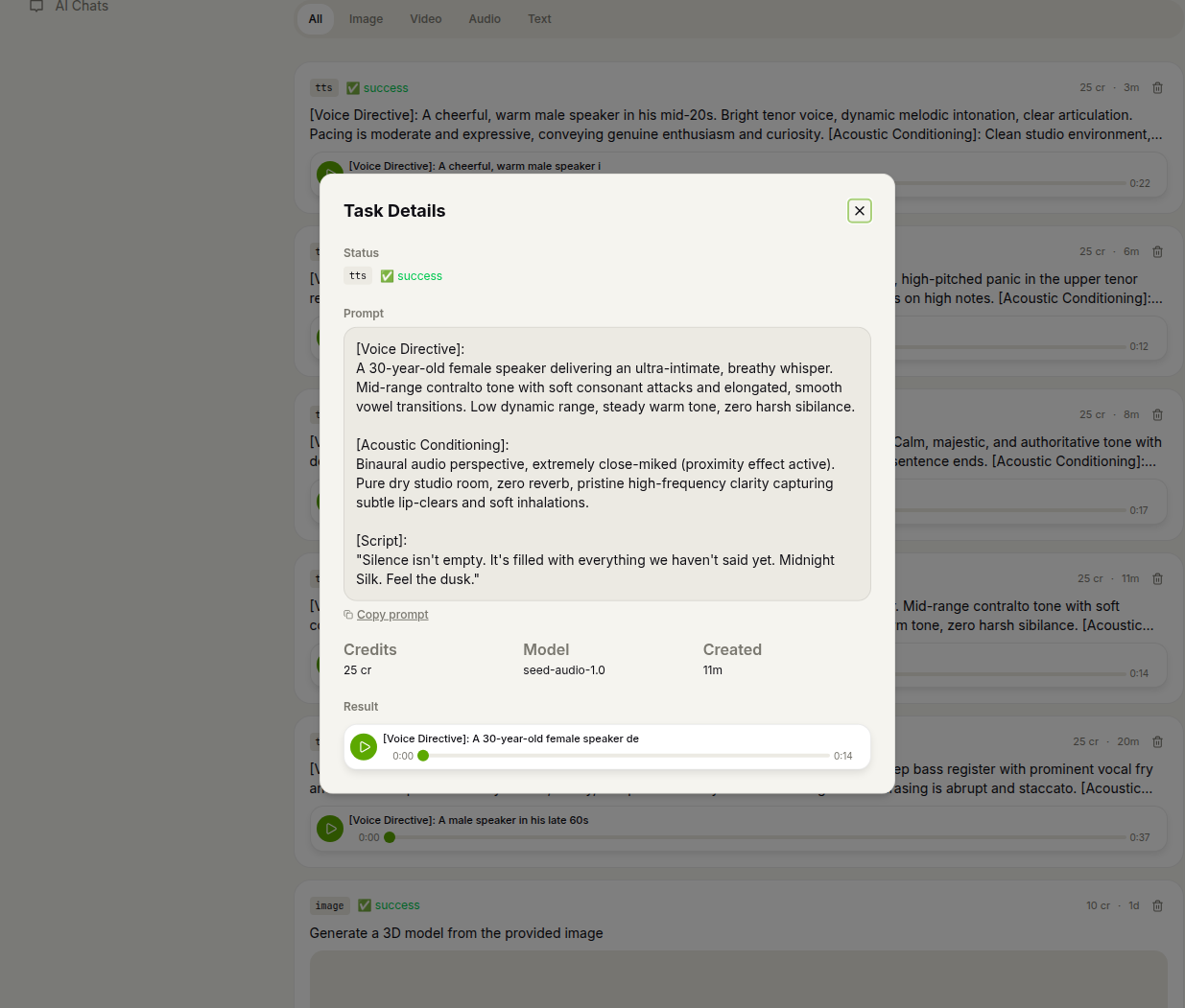
Produce a voiceover for a luxury fragrance advertisement that feels hyper-intimate, sensual, sophisticated, and close to the listener's ear.
Prompt Engineering Strategy
Leverage the proximity effect and breath-to-tone ratios to achieve an ASMR-like intimate delivery.
[Voice Directive]:
A 30-year-old female speaker delivering an ultra-intimate, breathy whisper. Mid-range contralto tone with soft consonant attacks and elongated, smooth vowel transitions. Low dynamic range, steady warm tone, zero harsh sibilance.

[Acoustic Conditioning]:
Binaural audio perspective, extremely close-miked (proximity effect active). Pure dry studio room, zero reverb, pristine high-frequency clarity capturing subtle lip-clears and soft inhalations.

[Script]:
"Silence isn't empty. It's filled with everything we haven't said yet. Midnight Silk. Feel the dusk."
Acoustic Breakdown Analysis
- Timbral Result: Specifying
breathy whisperandsoft consonant attacksdampens harsh transient peaks (like 'p' and 't' plosives) and creates a wide stereo image. - Prosody: The pacing slows to under 100 WPM, creating space for ambient pads in post-production.
Case Study 3: Nature & History Documentary – "The Eternal Glaciers"
Objective
Create an authoritative, emotionally grounded, and resonant narrator voice suitable for a modern natural history documentary series (David Attenborough / Sigourney Weaver style).
Prompt Engineering Strategy
Focus on dynamic pitch control, clarity of diction, and balanced spectral resonance.
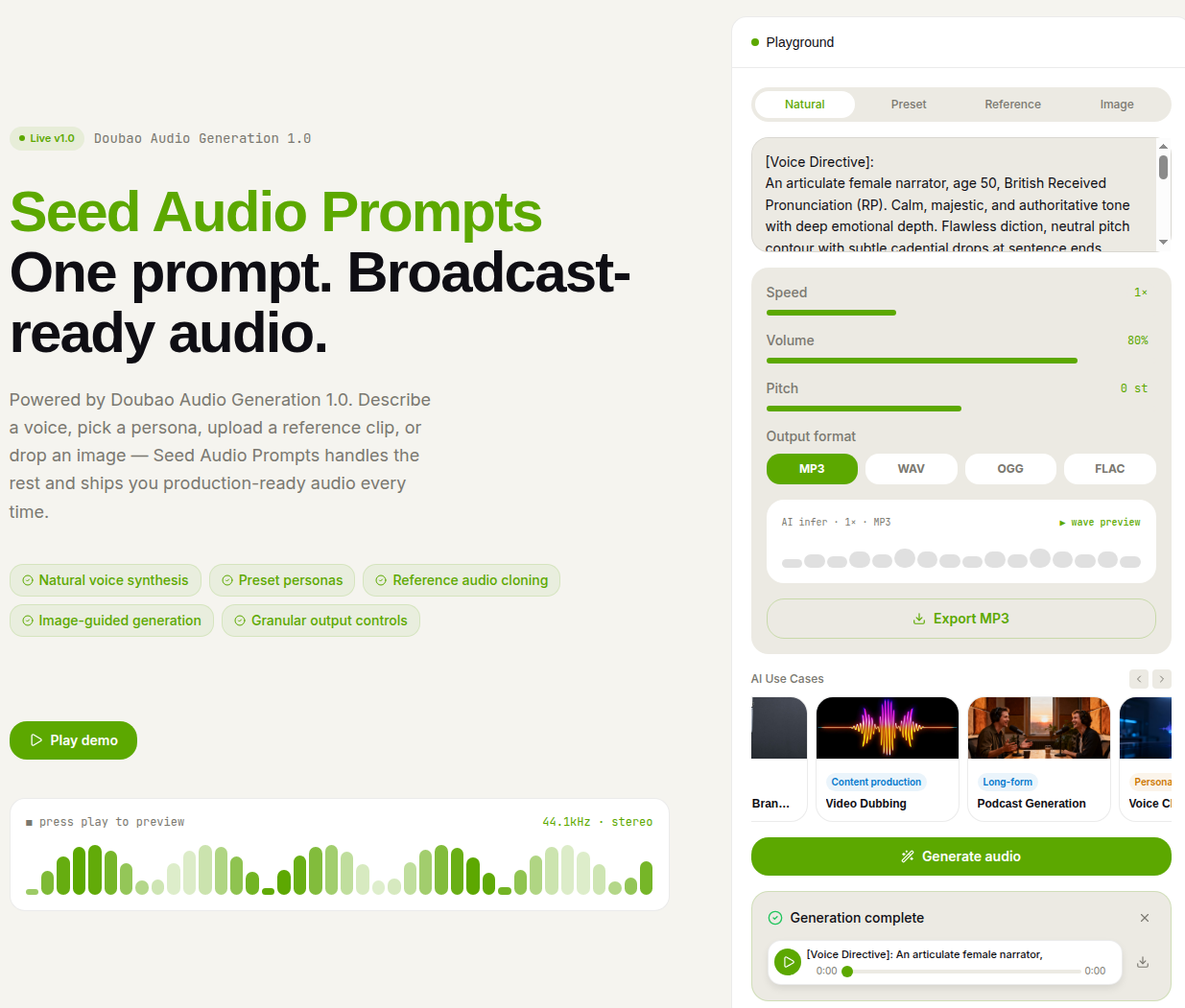
[Voice Directive]:
An articulate female narrator, age 50, British Received Pronunciation (RP). Calm, majestic, and authoritative tone with deep emotional depth. Flawless diction, neutral pitch contour with subtle cadential drops at sentence ends.

[Acoustic Conditioning]:
Professional broadcast narration booth. Balanced acoustic treatment, transparent frequency response, neutral distance (approx. 8 inches from diaphragm condenser microphone).

[Script]:
"For ten thousand years, this ice sheet has remained motionless. But beneath three miles of solid crystal, a hidden river is beginning to wake."
Acoustic Breakdown Analysis
- Timbral Result:
British Received Pronunciationestablishes clear vowel formants, whilecadential dropsensures natural, non-robotic phrase endings.
Case Study 4: Cinematic Thriller – "Emergency Transmission"

Objective
Generate a frantic, high-stress voice recording of an astronaut reporting a life-threatening system failure inside a pressurized suit.
Prompt Engineering Strategy
Inject physiological stress markers—shallow breathing, irregular pitch modulation, and helmet radio acoustics.
[Voice Directive]:
Male, 32 years old, distressed and hyperventilating. Voice is tight, strained, high-pitched panic in the upper tenor register. Rapid speech rate, uneven pauses, frequent sharp inhalations, cracked vocal chords on high notes.

[Acoustic Conditioning]:
Enclosed helmet comms system: bandpass filtered audio (300Hz - 3.4kHz frequency range), subtle radio static hiss, internal suit echo, heavy mechanical breath reflections.

[Script]:
"Control, do you copy?! Oxygen loop three just ruptured! I'm... I can't seal the valve! Primary pressure is dropping, four... no, three seconds!"
Acoustic Breakdown Analysis
- Timbral Result: The
bandpass filteredcondition restricts frequencies to telephonic bands, whilecracked vocal chordsinduces controlled audio instability in Seedance's latent generation.
Case Study 5: EdTech K-12 Interactive Tutor – "Curious Physics"
Objective
A warm, highly engaging, empathetic, and clear voice designed to hold the attention of young learners without sounding overly cartoonish.
Prompt Engineering Strategy
Balance cheerfulness with instructional clarity, utilizing mid-to-high pitch variabilities and bright timbres.
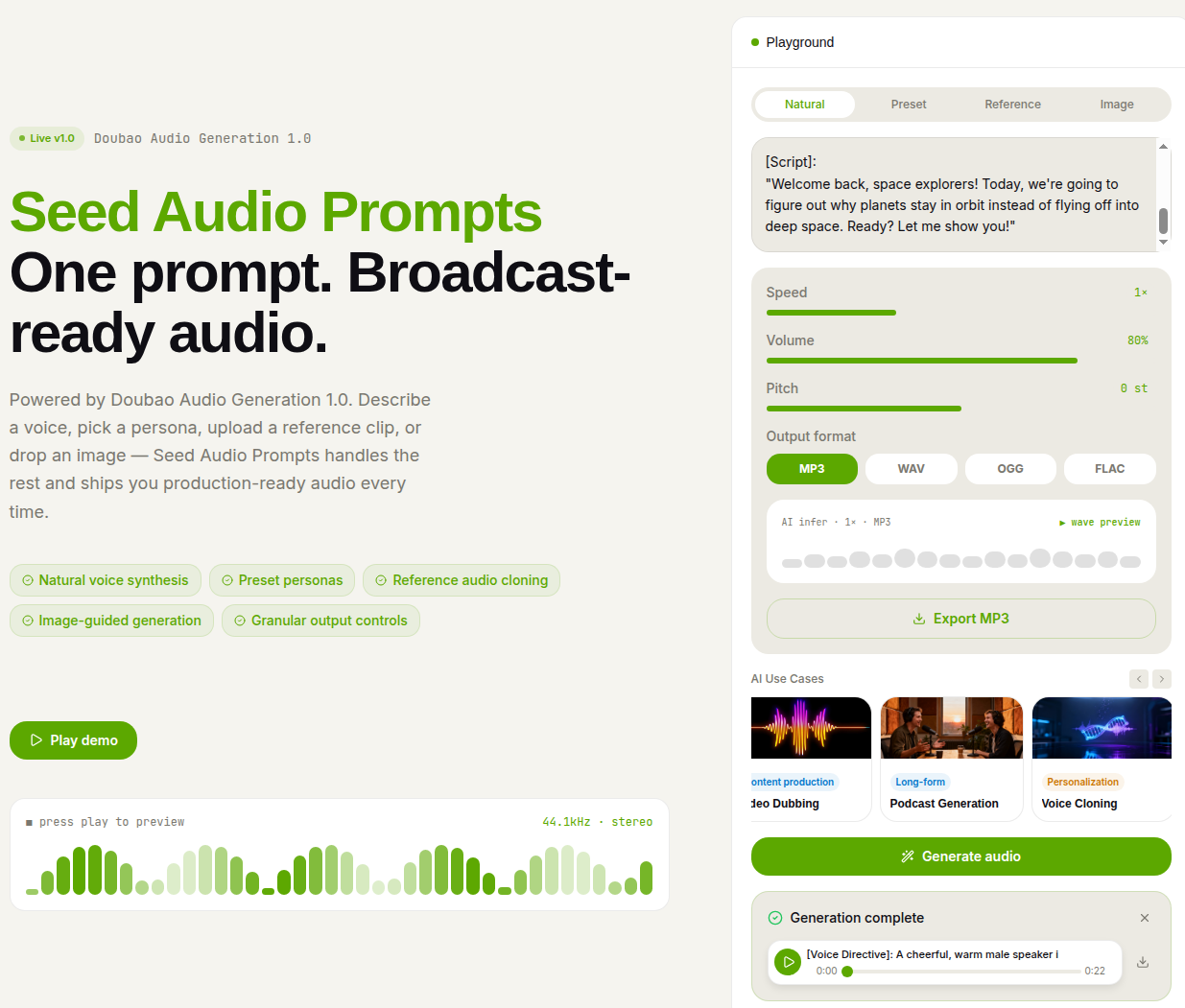
[Voice Directive]:
A cheerful, warm male speaker in his mid-20s. Bright tenor voice, dynamic melodic intonation, clear articulation. Pacing is moderate and expressive, conveying genuine enthusiasm and curiosity.

[Acoustic Conditioning]:
Clean studio environment, light room warmth, dynamic broadcast processor setting for consistent volume level and punchy mid-range.

[Script]:
"Welcome back, space explorers! Today, we're going to figure out why planets stay in orbit instead of flying off into deep space. Ready? Let me show you!"
Part 4: Advanced Prompt Engineering & Troubleshooting
Even with structured prompts, generative audio models can sometimes hallucinate acoustic artifacts or fail to capture subtle directions. Below are advanced techniques and troubleshooting remedies.
+-----------------------------------------------------------------------------------+
|                        TROUBLESHOOTING SEEDANCE AUDIO OUTPUTS                     |
+-------------------+---------------------------+-----------------------------------+
| Issue             | Root Cause                | Recommended Prompt Adjustment     |
+-------------------+---------------------------+-----------------------------------+
| Robotic/Monotone  | Lack of emotional subtext | Add prosodic variation cues       |
| Muffled Audio     | Over-specified dampening  | Request 'crisp studio condenser'  |
| Unintended Noise  | Conflicting textures      | Remove competing descriptors      |
| Pitch Instability | Over-long prompt script   | Split script into shorter blocks |
+-------------------+---------------------------+-----------------------------------+
1. Eliminating Robotic Cadence (Prosody Injection)
When Seedance sounds flat, inject explicit punctuation and prosody markers directly into the script text alongside your voice prompt:
- Use ellipses (...) for natural hesitant pauses.
- Use hyphens (-) for abrupt interruptions or glottal holds.
- Use ALL CAPS sparingly to emphasize specific pitch spikes.
2. Managing Vocal Strain & Artifacts
If your prompt requests extreme vocal states (e.g., "screaming", "crying", "heavy sobbing"), Seedance may introduce unwanted digital clipping or audio corruption.
- Fix: Balance harsh descriptors with stabilization prompts.
- Instead of:
Screaming in agony, distorted audio. - Use:
High emotional intensity, strained loud vocal projection, clean studio capture, distortion-free.
- Instead of:
3. Controlling Accent Bleed
When prompting regional accents, Seedance may over-caricature the voice. To prevent this, use subtle modifier scales:
- Mild:
A subtle hint of a Scottish lilt. - Moderate:
A clear, natural Edinburgh accent. - Strong:
A pronounced, heavy Highland accent.
Conclusion: Crafting the Future of Synthetic Voice
Prompting Seedance Audio for voice characteristics is both an art form and a precise acoustic discipline. By moving away from simple emotion labels and adopting structured, multi-layered prompts that account for vocal age, physical texture, dynamic prosody, micro-mechanics, and spatial acoustics, creators can achieve production-ready, deeply expressive voiceovers tailored to any creative media.
As generative audio models continue to evolve, mastering the syntax of voice prompting will remain the definitive skill for audio directors, developers, and media creators shaping the future of interactive sound.
